Application programming interfaces, commonly called APIs, sit at the centre of modern digital ecosystems. They act as communication bridges that allow different software systems to share information and functionality.
Businesses rely on APIs to connect platforms, exchange data with partners, and power mobile apps or web services. For example, when a mobile banking app retrieves your account balance, it usually does so through an API that securely requests the data from the bank’s servers.
Yet this connectivity introduces risk. Every connection point becomes a potential entry route for attackers. If an API is not properly protected, someone may attempt to exploit it to gain access to systems or data. That is why developing a secure API strategy has become essential for organisations that rely on connected digital systems.
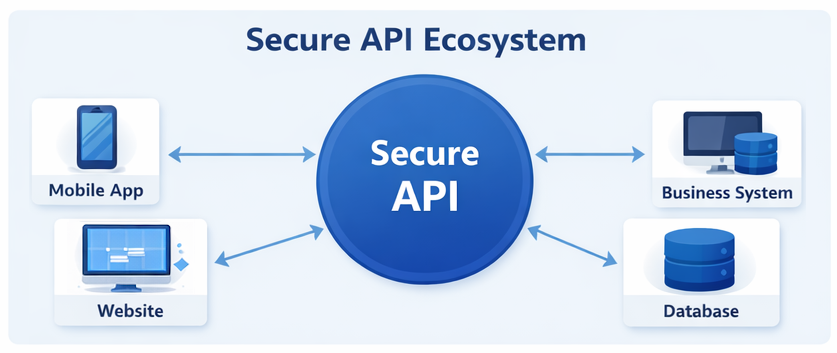
This post explores how a secure API works in practice and how to protect them. Rather than exploring the detailed technical explanations of APIs, we look at governance, monitoring, risk management, and practical steps organisations can take to build stronger API security over time.
If you would like a deeper explanation of how APIs work, click the link below:
👉 What is an Application Programming Interface (API)
What is a Secure API?
A secure API is an interface designed to safely exchange data between systems while preventing unauthorised access, manipulation, or abuse. The system uses controlled access, monitoring, validation, and defensive architecture to ensure that only legitimate users and applications can interact with it.
In simple terms, a secure API allows other systems to communicate with it, while protecting the data, services, and infrastructure behind it.
Public vs Private APIs: Security Considerations
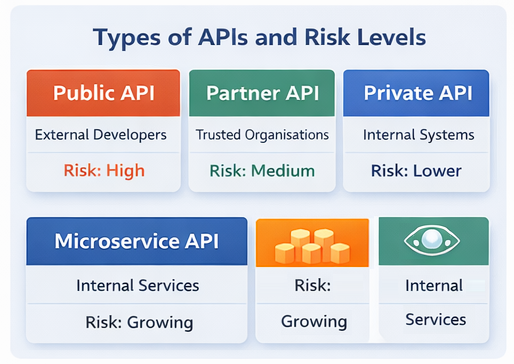
Application programming interfaces can be designed for different audiences. Some are exposed to developers outside the organisation, while others operate entirely within internal systems.
These different environments create different security challenges. A secure API strategy must recognise the differences between public, partner, private, and internal microservice APIs, because each type requires its own approach to protecting it.
Public vs Private APIs Explained
The table below shows how security priorities differ across API types.
| API Type | Typical Use | Security Focus | Risk Level |
|---|---|---|---|
| Public APIs | Used by external developers or customers | Strong authentication, traffic filtering, API rate limiting | High |
| Partner APIs | Shared with specific partner organisations | Controlled access, monitoring, contract governance | Medium |
| Private APIs | Used internally within company systems | Identity management, network security controls | Lower |
| Microservice APIs | Communication between internal services | Service authentication, zero trust architecture | Increasing |
Public APIs face the highest exposure because they accept requests from outside systems. Private APIs are typically protected inside organisational networks, but they still require strong security controls to prevent misuse or internal breaches.
Why API Security is Important
Once APIs become part of everyday operations, they often handle sensitive information and important system functions. This means a weakness in a single endpoint (the specific digital “doorway” where an API receives a request) can affect far more than just one application.
Without a secure API approach, attackers can potentially access:
- customer information
- internal systems
- payment data
- operational processes
A single vulnerable endpoint can create widespread consequences.
Real World Scenarios Where APIs Create Risk
🔐 Customer Portals
Online accounts often rely on APIs to retrieve profile data, orders, or account balances. If the API is not secure, attackers may access information simply by manipulating requests.
🧭 Mobile Apps
Most mobile apps connect to backend services through APIs. A poorly protected mobile API can expose entire databases.
📦 Third Party Integrations
Companies frequently connect logistics, payments, or CRM systems. If one partner integration lacks a secure API, the weakness can affect the entire network.
📊 Automated Data Sharing
Businesses exchange data with analytics tools, AI platforms, and automation systems. Every connection increases the importance of protecting APIs effectively.
These scenarios illustrate why API security risks are now considered a major cybersecurity concern.
How Does a Secure API Work?
A secure API relies on multiple layers of protection rather than a single security feature. Each layer helps control how requests are made and how data flows between systems.
A simplified process looks like this:
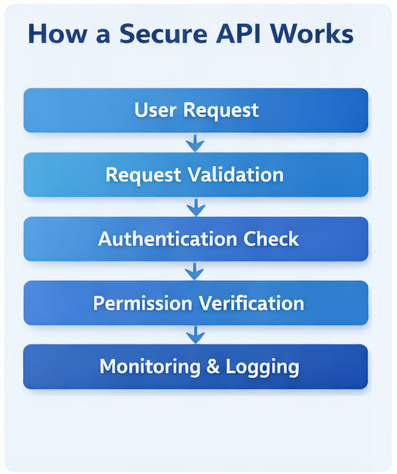
User Request – The user performs an action that triggers a request to the API, such as clicking a button in an application.
Request validation – The system checks that the request follows the correct structure and contains valid data before processing it.
Authentication check – The API verifies the identity of the requester using approved authentication methods.
Permission verification – Once the requester is identified, the system checks whether they are allowed to access the specific data or perform the requested action.
Usage monitoring – All activity is logged and analysed so that unusual behaviour or misuse can be detected.
Together, these layers create a controlled pathway for requests to move through the system. Each step reduces the chance that unauthorised users can access sensitive data or functions.
What Makes an API Secure?
The process above shows how requests move through a secure system. However, long term security depends on more than just technical checks. A secure API environment is created through the way systems are designed, maintained, and managed over time.
Organisations that treat APIs as long term digital products usually document them carefully, manage versions properly, and track how they are used across different systems. This makes it easier to control how integrations are introduced and how changes affect existing services.
This design mindset reduces accidental exposure, prevents uncontrolled integrations, and ensures that security controls remain consistent as platforms evolve.
How Do You Secure an API? A Practical Strategy
Organisations often ask a simple question: how do you secure an API?
The answer lies in building a structured strategy that spans the entire lifecycle of the system.
Key stages of securing APIs
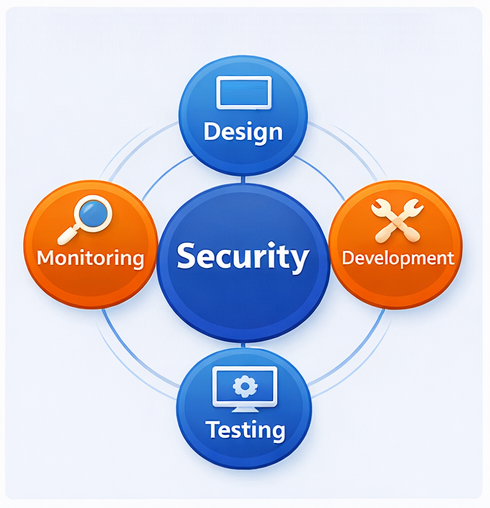
Design stage – Security rules should be planned before development begins. This includes defining authentication models and access rules.
Development stage – Developers implement validation, logging, and secure coding practices to reduce API security risks.
Testing stage – Security testing identifies weaknesses before the API goes live.
Operational stage – Once deployed, API monitoring and traffic management maintain a secure API environment.
Common API Security Risks Organisations Face
Many API vulnerabilities arise not from advanced hacking techniques but from simple design mistakes. Understanding the most common API security risks helps organisations prioritise their defences.
Frequent weaknesses in poorly secured APIs
- ⚠️ Exposed endpoints – Developers sometimes leave test endpoints accessible to the public internet.
- 🧪 Weak input validation – If systems do not validate incoming requests properly, attackers may inject malicious commands.
- 📡 Unmonitored integrations – APIs connected to partners or external platforms often lack proper API monitoring, making suspicious behaviour harder to detect.
When organisations focus on protecting APIs early in development, many of these problems can be avoided.
Key API Security Controls
API Authentication Methods Explained Simply
Authentication sits at the centre of any secure API environment because it answers a simple question. Who is making the request? Different systems use different authentication approaches depending on how the API is accessed and how sensitive the data is.
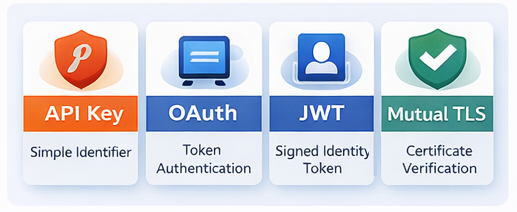
API Keys
API keys are one of the simplest methods. A key acts as a unique identifier that is attached to each request made to the API. The system checks the key to recognise which application is sending the request. This method is often used for basic integrations or internal services where the risk level is lower. However, API keys alone are not always sufficient for sensitive systems because they mainly identify the application rather than the individual user.
O Auth
OAuth tokens are widely used in modern web and mobile applications. Instead of giving a system permanent access credentials, OAuth issues temporary tokens after a user logs in through an identity provider. These tokens expire after a period of time, which reduces the risk if they are intercepted. Many large platforms use OAuth when allowing external applications to access user accounts with permission.
JWT
JSON Web Tokens, often called JWT tokens, store verified information about the user inside a digitally signed token. The token can include details such as user identity and access permissions. Because the token is signed, systems can confirm that the information has not been altered. This approach works well in scalable cloud systems where many services need to verify user identity quickly.
Mutual TLS
Mutual TLS, sometimes called mTLS, takes a stricter approach. Both systems verify each other’s identity before any data is exchanged. Each side presents a digital certificate, proving that it is an authorised system. This method is commonly used in high security environments such as financial platforms or government systems where services must strongly verify each other before communicating.
Each of these approaches solves the same core problem, confirming identity, but they do so in slightly different ways depending on the environment and level of risk.
The Role of API Rate Limiting in Security
Many cyber-attacks rely on sending large numbers of automated requests. This technique attempts to guess passwords, scrape data, or overwhelm systems.
API rate limiting helps stop these behaviours.
Instead of allowing unlimited requests, systems define how often an API can be used within a specific time period.
For example:
- 100 requests per minute per user
- 1000 requests per hour per application
- stricter limits for unknown sources
This simple mechanism helps maintain a secure API by slowing automated attacks and protecting infrastructure.
Why API Monitoring Is Critical for Security
Even the most carefully designed security architecture still needs oversight. Systems change, traffic patterns evolve, and attackers constantly search for weaknesses. This is why API monitoring plays an important role in protecting connected systems.
These systems record requests, analyse behaviour patterns, and help technical teams understand what normal activity looks like.
What Effective API Monitoring Looks For
📊 Unusual Traffic Patterns
One important signal is unusual traffic patterns. If a normally quiet API suddenly receives thousands of requests within a few minutes, it may indicate an automated script or bot attempting to probe the system. By spotting these spikes early, teams can investigate the cause before it escalates.
🔎 Repeated Authentication Failures
Another warning sign appears through repeated authentication failures. When the same account or IP address repeatedly fails to access an API, it may suggest that someone is trying to guess credentials or exploit weak login protection. Monitoring systems highlight these patterns so administrators can respond quickly.
📉 Unexpected Usage Locations
Monitoring can also reveal unexpected geographic activity. If an API normally receives requests from the United Kingdom but suddenly receives large volumes of traffic from unfamiliar regions, it may signal that an account has been compromised or that automated tools are targeting the service.
🧭 Changes in Response Patterns
Changes in response behaviour can also indicate problems. For example, if an API suddenly begins returning a high number of errors or unusually slow responses, it could suggest that the system is under stress, misconfigured, or being manipulated through repeated requests.
Effective API monitoring transforms a passive system into a proactive secure API defence.
Common Mistakes When Protecting APIs
Even organisations that take security seriously sometimes introduce weaknesses through simple oversights. These problems rarely appear because of complex attacks. More often they arise during design decisions, rushed development, or poor system maintenance.
Frequent pitfalls
🚫 Ignoring Security During Early Development
One common issue occurs when security is added too late in development. Teams may focus first on functionality and performance, leaving protection measures until the end of the project. By that stage, redesigning the API structure becomes difficult, and shortcuts are often taken. Building security into the design from the beginning usually produces stronger and more consistent results.
📂 Overly Permissive Data Responses
Another mistake is returning more data than necessary. APIs are designed to deliver information quickly, but if a request returns full data records when only a small piece of information is required, it increases the amount of sensitive data exposed through the interface. Limiting responses to only the required fields reduces unnecessary risk.
🧪 Insufficient Testing
Insufficient testing also creates problems. Some APIs are released after only basic functional testing, which means security flaws remain unnoticed. Proper testing should include checking how the system behaves when it receives unexpected inputs, unusual request patterns, or incomplete data.
🔄 Unmanaged API Versions
A final issue appears when older API versions remain active. Over time, systems evolve and new versions are introduced. If previous endpoints remain accessible indefinitely, they may contain outdated security controls or undocumented behaviour. Attackers often search for these older interfaces because they are easier to exploit.
Recognising these patterns helps organisations build a stronger secure API approach.
How Businesses Protect APIs in Practice
Understanding theory is helpful, but organisations benefit most from seeing how protecting APIs works in real situations.
Example: Online Retail Platforms
A retailer may operate:
- a customer mobile app
- a payment processing service
- a logistics tracking system
- a customer support platform
Each system exchanges information using APIs. A secure API strategy ensures:
- 🛍 Customer authentication is validated before retrieving order history.
- 🚚 Shipping updates are verified so attackers cannot manipulate delivery data.
- 💳 Payment requests are encrypted and monitored for unusual patterns.
- 📈 API monitoring tools track abnormal traffic spikes, helping detect automated fraud attempts.
Future Trends in Secure API Strategy
API usage continues to grow rapidly as digital systems become more interconnected. Security strategies must evolve accordingly. Several trends are shaping the future of protecting APIs.
Emerging developments
🌐 Zero Trust Architecture
One major shift is the adoption of zero trust architecture. In traditional networks, systems often trusted requests coming from inside the organisation. Zero trust removes that assumption. Every request must prove its identity and permission before access is granted, regardless of where it originates.
🤖 AI Driven Threat Detection
Another development is the use of AI driven threat detection. Machine learning systems analyse large volumes of API traffic and learn what normal behaviour looks like. When unusual patterns appear, the system can flag them automatically, allowing security teams to investigate potential threats more quickly.
📊 Advanced API Monitoring Platforms
Organisations are also adopting specialised API monitoring platforms. Traditional network monitoring tools were designed mainly for server traffic and infrastructure. New platforms focus specifically on API behaviour, providing detailed insights into how data moves between systems and where unusual activity might appear.
🔗 API Governance Frameworks
Finally, many companies are introducing formal API governance frameworks. These frameworks define rules for how APIs are designed, documented, published, and maintained. Governance ensures that security considerations are applied consistently across all development teams rather than handled differently by each project.
Together, these developments reflect a broader shift in how organisations think about digital infrastructure. APIs are no longer small technical components. They are central pathways through which modern systems exchange data and functionality. Protecting them has become a strategic priority for organisations building connected digital services.
The Role of Custom Software in API Security
As organisations expand their digital platforms, the number of internal and external API connections often grows rapidly. When systems are built independently, inconsistencies often appear in how protecting APIs is handled.
Custom software development can help create a consistent secure API architecture by:
- standardising API authentication methods
- applying consistent API rate limiting rules
- implementing shared API monitoring frameworks
- ensuring security is built into integrations from the start
Companies such as BSPOKE Software focus on designing integrations and platforms where protecting APIs is part of the overall system architecture rather than an afterthought. Only a small portion of the overall security strategy involves development itself. However, designing systems correctly from the beginning helps organisations maintain a reliable secure API environment as they scale.
BSPOKE Software helps organisations design and implement secure integrations, ensuring that APIs remain reliable, scalable, and protected as digital systems grow. If you require a custom software system that will need one or more integrations with third party software, our team can help design, develop and secure them, from the start.
Contact BSPOKE Software to discuss your project.